Comparisons
DaemonCore occupies a specific position in the AI stack. Understanding how it relates to existing tools clarifies where it fits.
Agent Frameworks
LangChain, CrewAI, AutoGen, Semantic Kernel
What They Do Well
- Provide scaffolding for building AI agents
- Handle conversation management and memory
- Integrate tools and external services
- Orchestrate multi-agent workflows
Where They Stop
- Safety is typically advisory (via prompts)
- No enforcement layer beneath the framework
- Governance tied to specific framework patterns
- Vendor-specific implementations
Where DaemonCore Sits
DaemonCore operates beneath agent frameworks. Agents built with LangChain, CrewAI, or any framework can run on top of DaemonCore. The governance layer enforces boundaries that the framework cannot override.
AI-Enhanced IDEs
Cursor, GitHub Copilot, Codeium, Continue
What They Do Well
- Integrate AI assistance into development workflow
- Provide context-aware code suggestions
- Enable natural language code generation
- Streamline developer productivity
Where They Stop
- Focus on single-user, single-session interactions
- Limited multi-agent coordination
- No structural governance layer
- Context resets between sessions
Where DaemonCore Sits
IDEs are applications. DaemonCore is infrastructure. An IDE could be built on top of DaemonCore to gain persistent context, multi-agent coordination, and enforced safety boundaries across sessions.
Enterprise AI Platforms
Internal systems at large technology companies
What They Do Well
- Production-grade infrastructure
- Sophisticated safety controls
- Multi-agent orchestration at scale
- Deep integration with internal systems
Where They Stop
- Proprietary and not available externally
- Designed for specific internal use cases
- Governance built into orchestration layer
- Require massive engineering investment
Where DaemonCore Sits
DaemonCore provides a public governance specification that enables similar capabilities without building everything from scratch. It's not a competitor to internal platforms — it's infrastructure that could underpin them.
Model Providers
OpenAI, Anthropic, Google, Mistral, open-source models
What They Do Well
- Provide the underlying reasoning capabilities
- Handle natural language understanding
- Implement model-level safety measures
- Scale inference infrastructure
Where They Stop
- No cross-model governance
- Each provider has different safety approaches
- Orchestration left to users
- No persistent context layer
Where DaemonCore Sits
DaemonCore operates above model providers but beneath orchestrators. It provides unified governance across any model — Claude, GPT, Gemini, or open-source — with consistent safety boundaries regardless of which model is executing.
The Layer Diagram
This diagram shows where each category fits:
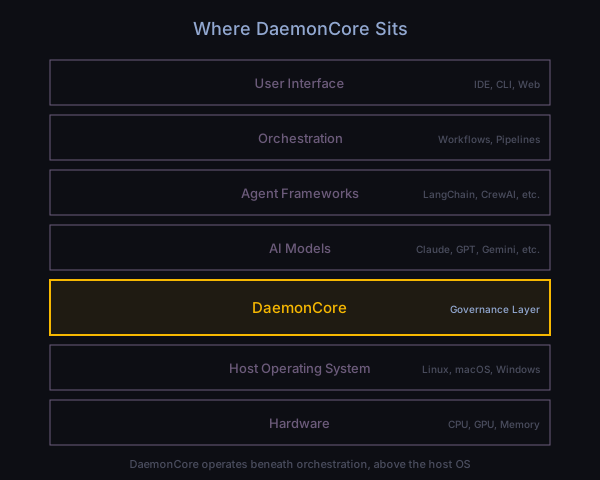
DaemonCore is not a replacement for any of these layers. It's the missing foundation that makes the layers above it governable.
How Governance Works
Regardless of which orchestrator or framework you use, DaemonCore enforces boundaries through:
Action Protocol
All agent outputs pass through protocol validation. Only well-formed, permitted actions proceed.
MAX Messaging Bus
Agent-to-agent communication is typed and schema-validated. No unstructured message passing.
Preflight Classification
Requests are classified before execution. Scope, risk level, and permissions checked upfront.
What's Available Now vs Coming
V1 (Current)
Protocol validation, schema enforcement, template constraints, deterministic boot, audit logging.
V1.5 (Planned)
Cryptographic action signing, hardware attestation, cross-agent capability delegation.